

Today has been an interesting day if you were watching the Houston Texans’ Twitter (yes, I know it is X, but let’s be honest…it is Texans Twitter). C.J. Stroud and $70 million were the hot topics.
Jeremy Branham of ESPN 97.5 Radio posted his opinion regarding what Houston Texans quarterback C.J. Stroud is looking for in a new contract. A post that has garnered over 2.5 million views and counting.


I understand Jeremy is in the opinion business, and he didn't post this as a sourced report. That’s not what I want to discuss in today’s article.
Is C.J. Stroud Worth $70 million Per Year?
That is a complicated question. Today? The answer is a quick no. Next offseason…maybe? The quarterback market is the one position that doesn’t always equate contract value with positional ranking. Quarterback contracts are about market positioning and timing. It is about who’s next. What contract needs to be barely topped to become #1?
C.J. Stroud undoubtedly has the most critical season ahead of him in terms of valuation for a large contract extension. After a rookie of the year performance in 2023, followed by two seasons of less-than-stellar play that culminated in a horrific playoff performance in the divisional round. Now it raises the question, “Should the Texans pay C.J. Stroud?” a big downgrade from “How much will Houston pay C.J. Stroud?”
Stroud has the opportunity to shift the question back to “how much?” with a solid performance in 2026. The chances of a contract extension during the 2026 league year appear to have no momentum.
Houston has contractual control with Stroud through the 2027 league year followed by two franchise tags. Stroud’s 2027 fifth-year option is valued at $25.9 million fully guaranteed.
Current Quarterback Market
Before we dive into this discussion, we need to examine the current quarterback market. If you have followed me long enough, you know I am a proponent of two contract metrics: APY percentage of the salary cap at signing and inflation-adjusted APY. Two metrics that capture the same idea, but from two viewpoints. Agents love these data points; NFL teams not so much.
The NFL salary cap has exploded in recent years. Similar increases are clearly coming down the pipeline.
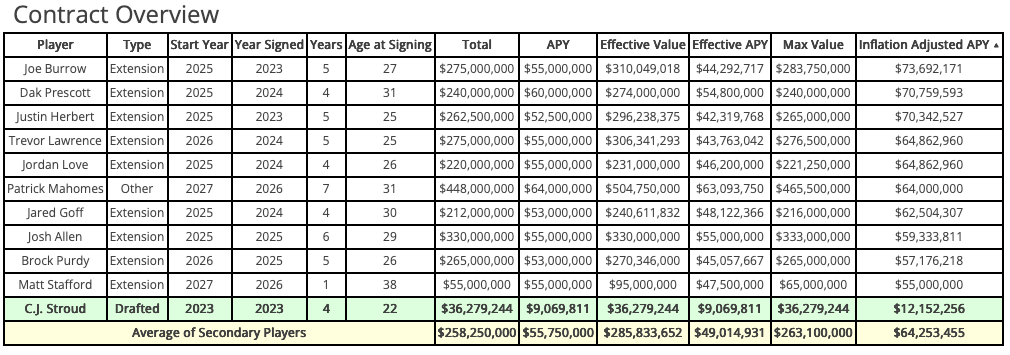
The average inflation-adjusted APY for the top 10 paid quarterbacks is $64.25 million. This coincides with the current APY of Patrick Mahomes, the highest-paid quarterback. (Every time I see the Burrow contract, I am reminded how strong it is)
Inflation-adjusted APY measures the contract's APY in the year it was signed, then increases it based on the rise of the NFL salary cap.
The next data point is APY expressed as a percentage of the league salary cap. This also captures inflation but from a different angle.
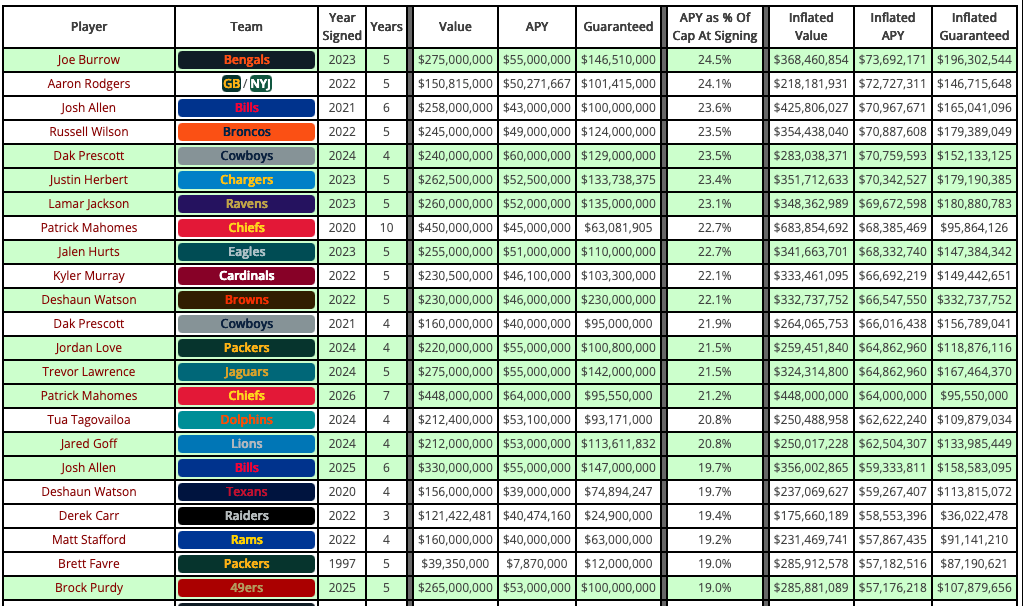
Contracts with green highlights are currently active.
The average of the top 10 paid quarterbacks, expressed as a percentage of the salary cap at signing, is 21.67%. With the 2026 league salary cap set at $301.2 million, that equals a contract APY of $65.27 million.
The $70 Million Sticker Shock
Start with the obvious problem.
Nobody in the NFL is currently making $70 million per year.
Dak Prescott’s contract carries a $60 million APY. Josh Allen, Joe Burrow, Trevor Lawrence, and Jordan Love are among the quarterbacks sitting around $55 million per year. Depending on how Patrick Mahomes’ contract is measured after its various adjustments, he’s also operating around the top of the quarterback market.
So a $70 million APY for Stroud wouldn’t merely reset the quarterback market.
It would take a running start and jump over it. And based purely on Stroud’s performance over the last two seasons, that’s difficult to justify.
His rookie season was spectacular. Stroud threw for 4,108 yards with 23 touchdowns against just five interceptions, posted a 100.8 passer rating, and immediately looked like one of the best young quarterbacks in football.
Then came 2024. His production dropped to 3,727 yards, 20 touchdowns, and 12 interceptions while his passer rating fell to 87.0.
There was improvement in some areas in 2025. Stroud finished with 3,041 yards, 19 touchdowns, and eight interceptions in 14 games while raising his passer rating to 92.9.
But the playoff performance, which included five interceptions over two postseason games, certainly didn’t strengthen the argument that Houston should immediately make Stroud the highest-paid quarterback in NFL history.
If we’re simply ranking quarterbacks based on performance today, Stroud doesn’t have a $70 million résumé.
But NFL contracts aren’t quite that simple.
Quarterback Market and Power Rankings
Earlier, I mentioned that the quarterback contract market doesn’t follow player power rankings. Quarterback contracts are about leverage and timing, whatever is needed to top the latest paid contract. Rarely do we see true market reseting deals.
Is C.J. Stroud better than Josh Allen, Patrick Mahomes, Joe Burrow, and Dak Prescott? On paper…honestly…no.
Therefore, the quick argument is that Stroud shouldn’t make more money than those players.
That’s just not how NFL contract markets work. Contracts are negotiated at different points in time under different salary caps with different leverage.
The quarterback market isn’t a permanent ranking of the best quarterbacks in football. It’s a moving market where the most recent franchise quarterback to sign often becomes one of the highest-paid players.
Trevor Lawrence didn’t receive $55 million per year because Jacksonville determined he was exactly as good as Joe Burrow. He received it because Jacksonville decided Trevor Lawrence was its franchise quarterback, and that was the neighborhood the quarterback market had reached.
Those are two very different things. And that’s why $70 million can’t simply be dismissed because Stroud isn’t currently a top-three quarterback.
Market Adjustments Are Coming
Some sort of market adjustment is coming for the quarterback market. Yes, Mahomes laid the groundwork to get the market to $64 million APY. A stagnant market was due for some adjustments. Players like Caleb Williams, Drake Maye, Jayden Daniels, and Bo Nix will reset the market and the contract floor by the summer of 2027.
Veterans who signed contracts in 2023, such as Joe Burrow, Justin Herbert, and Lamar Jackson, could be looking for revised contracts to catch up to a new market.
Based on some preliminary offline rumblings, that new $50 million contract floor will become $60 million. The new highest paid contract will be close to $70 million per year. At the latest, the $70 million will be eclipsed by 2028.
If we project the NFL league salary cap to rise to $315 million for 2027, then 21.67% becomes $68.3 million APY. Within 9 months (from today), the market has already adjusted another $3 million solely based on league salary cap growth.
The Franchise Question
The market is known. NFL teams know certain “cost of doing business” attributes are associated with quarterback contracts. There is no way to get around that fact.
The question Houston has to ask itself is, “Is C.J. Stroud our franchise quarterback?” If that answer is clearly a “yes,” then the contract is fairly easy; just follow the market.
I am not going to get into structure and contract length this time. This discussion is more about the franchise question rather than the minutiae of the contract itself.
And to be clear, I do not think Houston and Stroud (as of August 21, 2026) are close on a potential contract extension. This will drag into the 2027 offseason.
Houston's one upside is time. Stroud is under contract through the 2027 season. The team knows where the market is headed. From their viewpoint, paying an extra $10 million a year to confirm their trust in Stroud as the franchise quarterback is warranted.
And honestly, time is on Stroud’s side as well, provided his performance returns for the 2026 season.
Stroud’s camp knows a market adjustment is coming. Stroud has no good reason to sign an extension now. The current offers on the table are nowhere near the agent valuation.
Stroud’s best path is to bet on himself, play well in 2026, and wait for the market adjustment to happen. That market adjustment will raise the floor of any potential contract for quarterbacks looking for new contracts.
Closing
The quarterback market is due for adjustments. Multiple quarterbacks, both young and veteran, are in line to help drive that adjustment. Houston is entangled with that balance. As I said earlier, the quarterback market doesn’t behave like other position markets. Market, timing, and leverage all play a role in topping the last guy to become the highest-paid.
So, is C.J. Stroud worth $70 million per year today? No.
Could C.J. Stroud play well enough in 2026 that $70 million becomes a perfectly reasonable outcome next offseason? Absolutely.
And those two things aren’t contradictory.
Where do you stand on paying C.J. Stroud? Let me know in the comments below.
-TC
For sure, the team should wait until this season is in the books. Stroud has in no way earned the salary his team is asking for.
Great work as always Troy! One factor not mentioned that I think should be considered is Strouds concussion history. He's missed games from concussions in 2 of his 3 seasons and he's played poorly after coming back each time. Impacts the risk profile for each side.